Have you ever wondered how Netflix knows exactly what movie you’ll like, or how Google Maps predicts the fastest route? The secret behind these everyday wonders is Machine Learning (ML) — one of the most exciting fields in data science.
But don’t worry, you don’t need to be a tech wizard to understand it. Let’s break it down in simple, everyday language.
1. What is Machine Learning?
Think of Machine Learning as teaching a computer through examples, rather than giving it step-by-step instructions.
- In traditional programming, a developer writes rules:
If this happens → then do that. - In machine learning, we give the computer lots of data and let it figure out the rules itself.
Example:
If we want a computer to recognize cats in photos:
- Traditional programming → we’d write rules like “look for whiskers, fur, pointy ears.”
- Machine learning → we show the computer thousands of cat photos and non-cat photos. The computer then learns patterns that separate cats from everything else.
In short: we don’t teach the machine the rules; we teach it by examples.

2. How We Use ML in Everyday Life
You may not notice it, but ML is everywhere around you:
- Netflix & YouTube → recommend movies or videos based on what you’ve watched before.
- Google Maps → predicts traffic and suggests the best route.
- Online shopping → Amazon suggests items you might like.
- Email → spam filters keep junk mail out of your inbox.
- Voice assistants → Siri, Alexa, or Google Assistant understand and respond to your speech.
Machine Learning is quietly making your daily life easier.
3. Types of Machine Learning (Explained Simply)
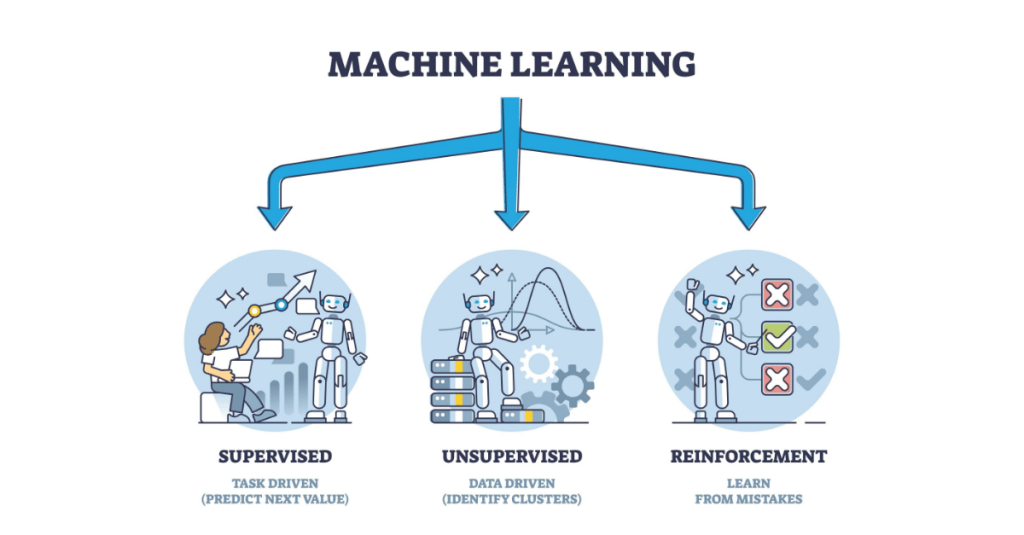
There are three main types of ML. Think of them like different ways humans learn:
- Supervised Learning (Learning with answers)
- Like teaching a child with flashcards: “This is an apple, this is a banana.”
- The computer learns from labeled data (input + correct output).
- Example: Predicting tomorrow’s sales based on past sales.
- Unsupervised Learning (Learning without answers)
- Like giving a child a box of toys and asking them to sort it however they want.
- The computer looks for patterns without any labels.
- Example: Grouping customers who like spicy chicken vs. mild chicken.
- Reinforcement Learning (Learning by trial and error)
- Like teaching a dog tricks with rewards and corrections.
- The computer learns by interacting with its environment.
- Example: A self-driving car learns how to drive safely by getting “rewarded” for correct actions and “punished” for mistakes.
4. Why is ML Powerful?
The power of ML comes from two things:
- Speed: Computers can learn from millions of data points in seconds.
- Improvement: The more data you give, the better the machine becomes.
That’s why ML is used for things humans can’t easily write rules for — like predicting diseases, spotting fraud, or recommending your next favorite song.
5. Final Thoughts
Machine Learning is not magic — it’s just computers learning patterns from data, the same way humans learn from experience.
For someone starting in data science, ML is an exciting area because it blends:
- Math
- Coding
- Real-world problem solving
So next time Netflix suggests a show you actually enjoy, remember — that’s Machine Learning at work!
 Kugathas ganeshan
Leave a comment